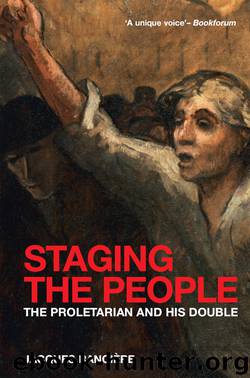
Staging the People by Jacques Ranciere
Author:Jacques Ranciere
Language: eng
Format: epub
ISBN: 9781844676972
Publisher: Verso Books
Published: 2013-04-17T04:00:00+00:00
It is this question of change and constancy that we have to dwell on for a moment. Beyond the grudges of some, the ambition or venality of others, something more important was involved: the Vichy state machine’s enlistment of a sizeable fraction of the trade-union apparatus. To analyse the origins and forms of this enlistment may lead to an analysis of modern terrorist power rather different from those who investigate the love for a Master or the ‘desire’ of the masses for fascism. It is perhaps worthwhile to reflect not just on the senility of Vichy or its converse childishness (jingle of decorations and presents from young girls; youth workshops and parades of old soldiers), but rather on its maturity or, if you like, its modernity: its ability to construct, in the shadow of outmoded dreams or indefinitely postponed projects, new forms of consensus or new circuits of power; not just on the excesses of fascist seduction and terrorism (the flames of torchlight retreats, autos-da-fé and crematoria) but on their everyday character – not in the sense in which some people speak of ‘ordinary fascism’, noting the germs of the great plague in the everyday frustrations of men like Georges Lajoie in the film Rape of Innocence, but rather in the sense in which the new power requisitioned the functions and powers needed to ensure the normal operation of a social body, in the sense of the panic that Godard refers to in connection with dreaming of the only true film about the death camps, one that would show us the mad work of administration that the death machine required.4 By applying in the most summary fashion the double rule of elimination of obstacles and utilization of skills, by offering the ministry of labour to René Belin, one of the secretaries of the CGT that it was about to dissolve, the Vichy state requisitioned in a new way the trade-union apparatus, its practice and its ideology. As the new minister needed both the help of trade-unionist skills and the force of trade-union pressure, the entire trade-union intermediary found itself solicited, caught up in the double play of its reality and its ideal: the reality being the defence of workers’ interests in time of war as in peace, under dictatorship as under democracy, the continuing confrontation with the reason of employers and state that had gradually placed it in the position of arbiter between the interests of the producers and those of national production; the ideal, constantly reasserted, being that of the emancipation of the proletarians and the fraternity of peoples. At a time when the realities of production and supply were glaring in their demands, while the ideals of peace and emancipation were uncertain in their application, trade-union collaboration would ceaselessly swing between a policy of lesser evil and the mystique of the new order.
What we must forcefully proclaim is that an old world has ended, a new world is being born.5
Download
This site does not store any files on its server. We only index and link to content provided by other sites. Please contact the content providers to delete copyright contents if any and email us, we'll remove relevant links or contents immediately.
| Anthropology | Archaeology |
| Philosophy | Politics & Government |
| Social Sciences | Sociology |
| Women's Studies |
The remains of the day by Kazuo Ishiguro(9005)
Tools of Titans by Timothy Ferriss(8403)
Giovanni's Room by James Baldwin(7353)
The Black Swan by Nassim Nicholas Taleb(7137)
Inner Engineering: A Yogi's Guide to Joy by Sadhguru(6799)
The Way of Zen by Alan W. Watts(6621)
The Power of Now: A Guide to Spiritual Enlightenment by Eckhart Tolle(5790)
Asking the Right Questions: A Guide to Critical Thinking by M. Neil Browne & Stuart M. Keeley(5779)
The Six Wives Of Henry VIII (WOMEN IN HISTORY) by Fraser Antonia(5519)
Astrophysics for People in a Hurry by Neil DeGrasse Tyson(5196)
Housekeeping by Marilynne Robinson(4455)
12 Rules for Life by Jordan B. Peterson(4312)
Ikigai by Héctor García & Francesc Miralles(4279)
Double Down (Diary of a Wimpy Kid Book 11) by Jeff Kinney(4278)
The Ethical Slut by Janet W. Hardy(4262)
Skin in the Game by Nassim Nicholas Taleb(4257)
The Art of Happiness by The Dalai Lama(4133)
Skin in the Game: Hidden Asymmetries in Daily Life by Nassim Nicholas Taleb(4012)
Walking by Henry David Thoreau(3969)
